Commission
21,39 The Secret of Alidades
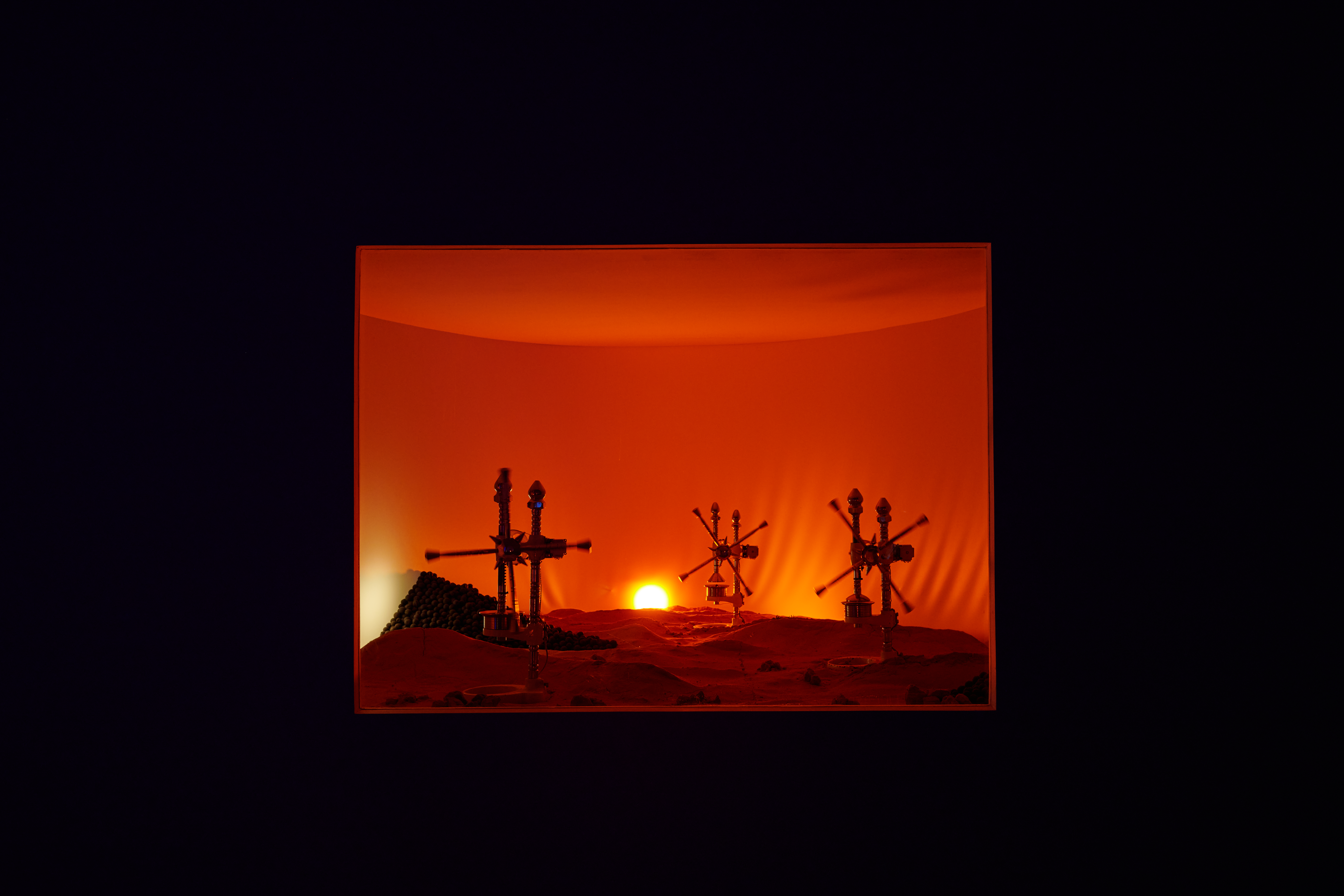
When she was a child, Bashaer Hawsawi spent a lot of time surrounded by an abundance of objects in her family’s home and the small store that her father owned as a hobby. She especially remembers her mother drying lemons and the citrus scent emitted. This recollection of childhood is at the center of Hawsawi’s untitled piece, which takes the form of a diorama. Emblematic of 19th-century Europe, this scenic device corresponds to a real environment behind a glass pane that uses paint and light to render the illusion of a landscape. It is reminiscent of the shops in Paris and London that began to appear simultaneously to display merchandise, becoming the first competitors in the field of aesthetic display in the industrial era. In this case, the diorama encloses the artist's memories and lends them an animistic appearance, with lemon presses turning on themselves without any function, calling to mind daily life and its repetitions. The memory is linked to trauma — but trauma placed at a distance from reality. In this respect, Hawsawi's device moves away from certain contemporary practices that attack the visual and where "the object- gaze is presented as if there were no scene to stage it, no frame of representation to contain it, no screen," to quote the American art critic Hal Foster. On the contrary, the artwork remains a possible place of reconciliation as it moves away from the abject and is understood within a psychoanalytical framework as something that everyone needs to let go of as a real subject